Lizards of the World
29 Species • 7 Families • Comprehensive Conservation Database
Species Database
29 species • Page 1 of 5
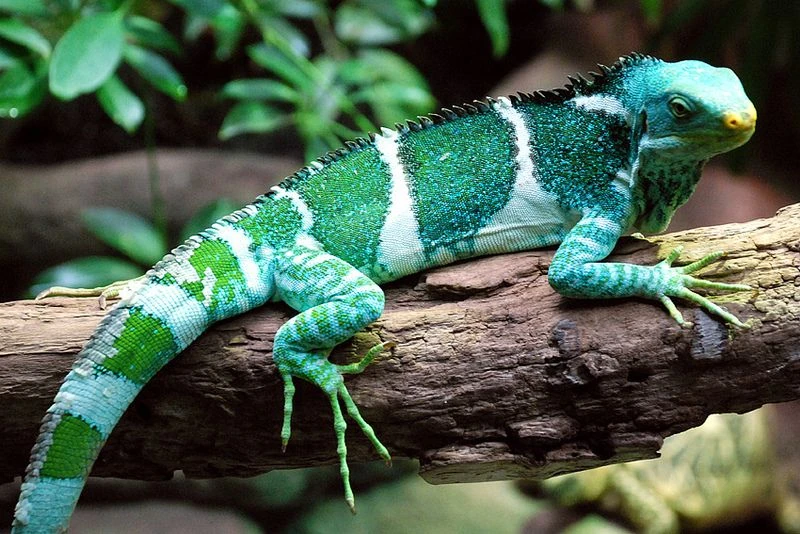
Fiji Crested Iguana
Brachylophus vitiensis
Overview
One of Fiji's most distinctive iguanas, the Fiji Crested Iguana features prominent dorsal spines and a distinctive yellow nose. Males display more defined dorsal spines and larger dewlaps for temperature regulation and mating displays. Currently, only 12,000-14,000 mature individuals remain in the wild.
Habitat
Forests and rocky areas (mountain peaks, cliffs) in Western dry half of Fiji
Physical Traits
Long tails, limbs, and fingers. Dark to light green color with blue shades and white bands across body. Males have darker green mixed with black speckles, females lighter green. Clearly defined white band with small crest at neck.
Distribution
Distributed around Vito Levu, Vanua Levu, Yasawa, and Mamanuca islands of Fiji
Behaviors
Threats
- Habitat loss
- Invasive species
- Climate change
What are Lizards?
Lizards are the most diverse group of the Squamate reptiles scattered across all continents except Antarctica. Although most lizards generally share similar anatomical and physiological characteristics, the Squamate group contains over 6,000 sub-species that vary in their diet, physical appearance, behavior, and overall distribution.
Most lizards are relatively small animals, like the Leopard Gecko that measures 15-25cm in length, except some like the Komodo Dragon that can grow up to 3m.
Some of lizards' distinguishing features are their rounded torsos with trunk bones that extend to the tail, short necks attached to quadrate skulls, four limbs/legs, and long tails. Similar to other reptiles, lizards produce overlapping scales that reduce water loss and act as protectors from the environment.
They have long tongues, some forked, stretching outside the mouth to catch prey or lick their eyes to clean themselves, as in the gecko lizards.
By the Numbers
Understanding the scale and urgency of lizard conservation
The Evolution of Lizards
The first land vertebrates, the Tetrapoda, appeared 397 million years ago. Through the Early Pennsylvanian Epoch, early tetrapods' evolution split into two, with one lineage leading to amphibians and the other to Amniota.
Fossil evidence from the Middle Pennsylvanian Epoch (318-312 million years ago) shows early reptiles together with synapsids. The earliest known true terrestrial reptile is the Hylonomus, a small forest-dwelling reptile similar to modern lizards, up to 25cm in length with small sharp teeth for catching insects.
Lizards are diapsids, part of the group Lepidosauromorpha, first thought to appear in the Late Permian. The evolutionary separations of lizards categorize into five key moments: 1) Diversification of Iguanas, 2) Evolution of Geckos (Scleroglossa), 3) Branching of Gekkonidae, 4) Diversification of Diploglossa, 5) and the Evolution of Snakes.
During these stages, lizards developed optical nerve systems to track moving prey and chemical sensory systems in their tongues for olfactory and food detection. Limbs changed by elongating, shortening, or even disappearing; tongues had functional revisions and for some species even split into two nodes.
By the late Jurassic period, the main branches of lizard evolution were determined: Iguana, Gecko, Tuatara, and Anguidae.
Anatomy
Lizards have dry skin with scales that vary in texture. In some species, the tail is fragile and can break off and regenerate, though not perfectly. Lizards adapt to various environments as they can swim, climb, and even glide; they have clawed or webbed feet that assist in climbing or traveling on water.
Lizards use their tongues to smell. Their tongue captures air particles and brings them into the mouth where a specialized organ detects the scent. Lizards also have external ears for better hearing than snakes.
Lizards have a three-chambered heart and are ectotherms (cold-blooded), meaning they must absorb heat from the environment. While their eggs fertilize internally, they lay eggs, though some give live birth.
Most lizards possess four limbs, an axial skeleton, and a similar anatomical layout to small mammals. They have a rigid skull and less mobile jaws than a snake with four rows of teeth, one on each jaw.
Some have specialized features like color-changing scales for camouflage (chameleons, anoles) or dewlaps - loose flaps of skin that can extend to intimidate or attract females.
Why are Lizards Becoming Endangered?
Statistics: While 4% of lizard populations have vanished in the past 35 years, 6% of the world's lizard species could disappear in the next 40 years. If climate change continues unmanaged, these numbers can increase to 20% in the next 70 years.
Global Warming: Due to significant increases in average global temperatures, lizards spend more time searching for shade to cool down and less time on activities linked to their survival. As temperature increases and gets too hot to forage, they may fail to search for food and provisions.
Case Study - Yucatan Peninsula: Predatory lizard species prefer to bask at 88°F. March temperature increased from 86°F (1970s) to 91°F (present), causing lizards to lose approximately four hours of hunting time. They cannot eat enough to stay healthy and can no longer reproduce.
Lizards that give birth to live young are particularly affected, as they have evolved slightly lower body temperatures; otherwise, their young can die or develop abnormalities. Larger species are also at higher risk as they have fewer locations to find shade and water.
Over-Collection: Over-collection affects certain species in some regions, where sought-after species are heavily targeted for the pet trade.
Habitat Destruction: Deforestation affects lizards differently at various altitudes. At lower elevations, it reduces population numbers. At higher elevations, population rises due to movement from lower elevations, but species disappear as it becomes too hot for original high-elevation residents.
Long-term Effects of Mass Extinction
According to 'World's Lizards Under Threat from Climate Change' from LiveScience, one-fifth of the world's lizard population will decrease by 2080, leaving a crucial impact on the food chain.
Lizards are highly sensitive to climate change, with 5% of total population already lost. In Mexico, 12% has gone missing; 30% in Southern Europe.
Lizards play an essential part in the food chain as they are the main predators of insects and prey of many species including birds and snakes. Therefore, the decrease of lizards will negatively impact the ecosystem:
- Bird and snake populations will diminish due to loss of prey
- Insect populations will boom without predator control
- Agricultural regions will be especially affected, reducing food sources for humans
If lizards, who act as a middleman between prey and predators, become extinct, the ecological balance will be severely disrupted.
Full Research Paper
Read the complete Lizards of the World research paper. You can view it here or download for offline reading.
Join the Conservation Effort
Every species in this database faces unique conservation challenges. Your awareness and support can make a difference in preserving these incredible creatures for future generations.